Published on Thursday, 19 November 2026 at 12:42:25 PM

Shire Trials Tyre Dragging on Gravel Roads This Harvest
This harvest, the Shire of Gnowangerup's works crew is trialling a different way of looking after our gravel roads. Instead of grading all the roads with the blade, one grader and one tractor are each towing a set of old large tractor tyres behind them to drag the road surface back into shape on selected roads.
A proven approach
This is not a new idea. The Shire of Chapman Valley uses tyre dragging over harvest and has had good results with it, and we are keen to see how it performs on Gnowangerup's roads and gravels.
Why change things over harvest?
By the time harvest arrives, there is very little moisture left in our unsealed roads. Grading with the blade works best when the gravel is damp enough to be cut, reshaped and compacted again. When the road is bone dry, blade grading tends to break up the hard, bound surface, leaving loose gravel and dust that does not bind back together. The road can end up rougher and corrugating faster than before it was graded, right when grain trucks and farm traffic are at their heaviest.
Dragging tyres is a lighter touch. The tyres knock the tops off corrugations, drag loose material back into wheel ruts and smooth out the running surface, without cutting into the compacted crust underneath.
If we do get some rain, the tyres can be quickly removed and the blade used to take advantage of the damper conditions.
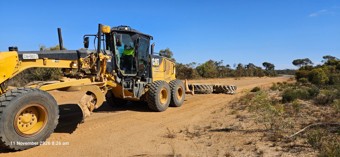
A Shire grader dragging tyres along a gravel road, November 2026.
More kilometres covered each day
Because the grader is not working the blade, it can travel the road more quickly than it can when dry grading. That means our operators can cover more kilometres per day and get across more of the network during the busiest time of year on our rural roads.
Why use a grader?
Without the tyres, the grader would be dry grading, which does more harm than good in these conditions. Towing tyres keeps it working on our roads without cutting up the surface. It also means the grader is ready to go: if rain gives us workable moisture, the tyres come off and the blade can go straight down.
A seasonal measure, not a permanent change
Tyre dragging is a tool for dry conditions, not something we will do 12 months of the year. When there is enough moisture in the roads to grade properly, our crews will go back to normal maintenance grading with the blade, which is still the right way to reshape roads, restore crossfall and fix drainage.
What you will see on the road
You may come across our grader or tractor towing a pair of large tyres on a chain. Please slow down when approaching and passing the grader or tractor, give it plenty of room, and watch for dust and loose material.

The tyre drag is chained to the rear of the grader.
Next step
At the end of harvest, we will evaluate how successful the trial has been, looking at how well the roads held up and how much of the network we were able to cover. The results will help us decide whether tyre dragging becomes part of our approach for future harvests.
Back to All News